

Background
The European Commission proposed a new Regulation in December 2025 to strengthen the EU’s biotechnology sector, which has fallen behind regions such as the United States and China due to ‘structural barriers in clinical development, regulation and manufacturing’. The proposal comprises the EU Biotech Act, which forms part of the EU’s broader strategy to improve competitiveness, attract investment and accelerate the development of innovative technologies and medicines.
Since the initial proposal, the scope of the Biotech Act has been broadened by the Commission and the Act itself split into two parts:
- Biotech Act I; establishes a framework to strengthen the competitiveness of the health biotechnology sector in the EU, which is discussed further in the next section.
- Biotech Act II; focuses on industrial biotechnologies, and biomanufacturing with the legislative proposal expected later in 2026.
EU Biotech Act I
The Biotech Act is intended to transform the pharmaceutical industry with the proposed first part of the Act aiming to attract innovation and investment to the EU and ultimately reducing the time required to bring novel medicines to market. The Commission hopes to achieve this by amending and simplifying the existing complex regulatory framework that encompasses:
- Regulation on Clinical Trials
- Regulation on Advanced Therapy Medicinal Products (ATMPs)
- Regulation on standards of quality and safety for substances of human origin intended for human application (SoHO)
- Regulation on Veterinary Medicinal Products
- General Food Law
- Legislation on the deliberate release of genetically modified organisms (GMOs)
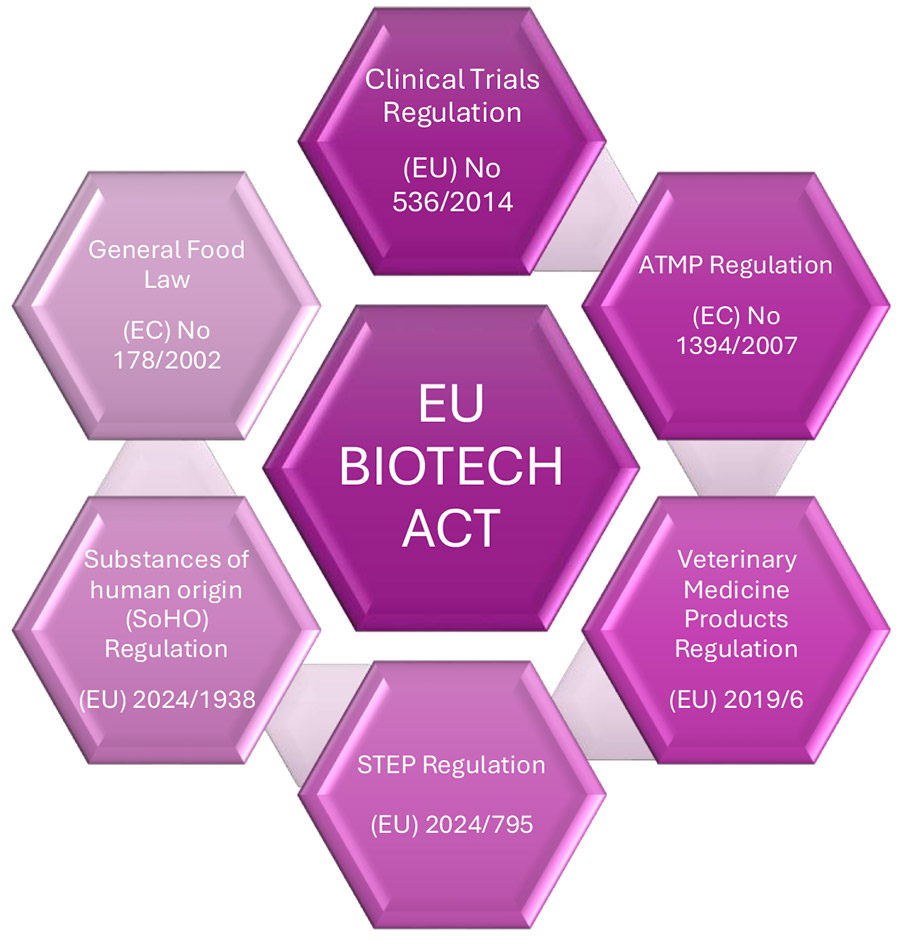
The proposal is designed to operate alongside the proposed revisions to the Medical Device Regulation (MDR) and In Vitro Diagnostic Medical Devices Regulation (IVDR) to ensure consistency and overall coherence across the wider EU regulatory framework.
Clinical Trial Regulation (EU) No. 536/2014
From a pharmaceutical industry perspective, one of the most significant changes arises from the proposed reforms to the Clinical Trial Regulation (CTR), which will be amended with an aim to facilitate earlier access to safe, effective, high-quality and affordable biotechnology products.
The Act envisages a simplification and streamlining of the procedures for clinical trials under the CTR. The proposed changes apply to all clinical trials regardless of whether the investigational medicine is a biological or chemical product, reflecting the core principle of the CTR, which is to create a harmonised EU-level system for clinical trial authorisations. The European Commission notes that limiting the scope of the envisaged amendments to biological medicines would introduce unnecessary complexity, create inconsistencies, and potentially create further barriers to multinational research.
The proposed amendments seek to reduce regulatory delays and administrative burdens while modernising clinical trial processes through accelerated approval timelines, greater flexibility for complex study designs, and increased use of digital technologies.
The main changes proposed are:
- Shortened timelines for assessment of multinational clinical trials: timelines are reduced to 75 days for initial authorisations and 47 days for substantial modifications, with a further reduction to 47 days and 33 days respectively where no requests for further information are issued. In addition, the additional 50-day timeline for Advanced Therapy Medicinal Products (ATMPs) is removed.
- Minimal-intervention clinical trials: introduction of a new category of minimal-intervention clinical trial for studies in which an authorised medicinal product is used in accordance with its marketing authorisation and where any additional diagnostic or monitoring procedures present no more than minimal risk or burden to participants. These trials will only require ethical review before commencement.
- Single core dossier for investigational medicinal products (IMPs): introduction of an IMP Core Dossier containing the key quality, safety and development information for an investigational medicinal product. Once established, the Core Dossier can be referenced across multiple clinical trials involving the same IMP. This will promote consistency of information, support efficient assessment and oversight, and facilitate product development. One Member State will act as the Core Dossier Depositary Member State, responsible for verifying the completeness and suitability of the dossier and managing any subsequent updates, while other Member States may rely on its assessment.
- Harmonised templates for Part II documents of a clinical trial application: use of mandatory harmonised templates across all Member States to simplify the application and assessment processes, with the option for Member States to rely on the assessment of a Reporting Member State for common aspects and elements in the Part II application, thereby reducing the duplication of work.
- Single authorisation process for combined studies: a dedicated pathway involving coordinated assessment across Member States, for the authorisation and conduct of combined studies involving a medicinal product used in combination with a medical device or an in vitro diagnostic medical device.
- Regulatory sandboxes: introduction of controlled experimental environments for the testing of innovative approaches in clinical trials outside the current regulations.
- Accelerated and simplified authorisation procedures during public health emergencies: Accelerated and simplified procedures will enable multinational clinical trials to be authorised and conducted more rapidly during EU-level public health emergencies and certain emerging serious cross-border health threats.
- Closer cooperation between and across Member States: expanded roles and responsibilities of the Clinical Trials Coordination and Advisory Group (CTAG) to issue or endorse guidance documents related to clinical trial conduct and supervision. In addition, strengthening of the reporting Member State’s role to lead the scientific, ethical, and regulatory assessment which will serve as a reference for the other Member States, and formally integrating the ethical review of Part I into the Part I reporting Member State assessment.
- Special provisions for clinical trials involving genetically modified organisms (GMOs): exemption from the need to submit an environmental risk assessment (ERA) for certain low-risk GMO-containing ATMP clinical trials.
- Direct delivery of IMPs to trial participants: IMPs and auxiliary medicinal products can be delivered directly to participants under the supervision of the investigator with the aim of reducing travel burden for participants whilst improving study retention rates.
- Personal data harmonisation: establishes a harmonised legal framework for processing personal data in clinical trials and limits additional national requirements, reducing divergence across Member States while maintaining compliance with the General Data Protection Regulation.
- Parallel substantial modifications: sponsors may submit certain substantial modifications concurrently that concern distinct and independent aspects of a trial, providing greater flexibility and reducing delays in trial management.
Current Timelines
The Act is continuing through the EU legislative process, with a first reading in the European Parliament anticipated in December 2026. Further updates to the proposals are therefore expected before the final text is adopted.
The current expectation is that the final adoption will take place in late 2026 or 2027, with entry into force around 2027 to 2028, however, the formal timelines have not been published to date.
Conclusion
The proposed reforms under the EU Biotech Act I represent one of the most significant updates to the European clinical research framework since the introduction of the Clinical Trial Regulation. By reducing approval timelines, promoting harmonisation across Member States, and enabling greater use of digital technologies and innovative trial designs, the legislation aims to strengthen Europe’s competitiveness in biotechnology research and development while improving patient access to innovative therapies without compromising safety, quality, or ethical standards. If adopted, the reforms are intended to make the EU a more attractive and competitive region for biotechnology and the development of innovative medicinal products.
How can S-cubed help you?
We hope you found this article useful. If you have any questions on this topic or want to reach out regarding any aspect of your own development programme, please don’t hesitate to get in touch. Additionally, S-cubed can prepare and coordinate all the necessary regulatory documentation you may require for a clinical trial application in the EU and UK, including authoring IMPDs and IBs and ensuring these meet the relevant regulatory requirements to managing the trial application throughout the life-cycle of the trial.
Any Questions?
If you have any questions on this topic or want to reach out regarding any aspect of your own regulatory programme, please don’t hesitate to get in touch. You can contact us here via our website, or by email (info@s-cubed.co.uk), or by telephone (S-cubed Ltd: +44 1235 77 22 60).